Google+


Showing posts with label Legend 3D. Show all posts

Monday, November 06, 2017

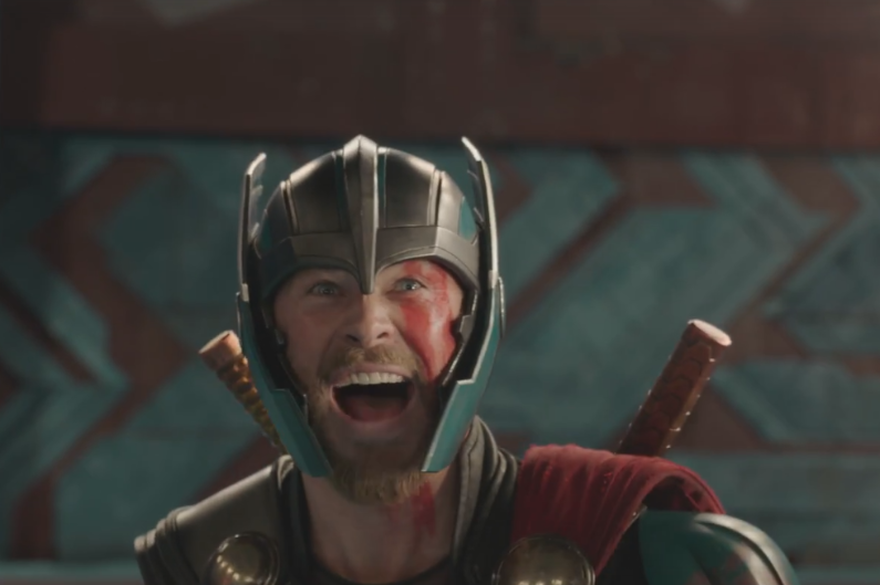
THOR: RAGNAROK Is Hilariously Well Done... Except For The 3D

Well as they say, I have good news and bad news. The good news is THOR: RAGNAROK is absolutely hilarious and I love what they've done to bring in those laughs. No spoilers in this review by the way. 

There were some very imaginative jokes and gags in the movie - and I simply loved Jeff Goldblum in this!! Perfectly cast if you ask me.

HOWEVER (and it's in all caps) the bad news is the 3D conversion is quite poor at times, frankly. Mind you, the digital visual effects are all superb in 3D as they are rendered natively in 3D - but of course they don't rely upon post-conversion. But the converted optics? *Sigh* Put it to you this way, in the scene with Odin on the cliff fields, the grass is so lazily or cheaply converted that there are clumps of flat grass mixed in with the usual dimensional depth of the location. It was HORRIBLE. It was so bad that it took me out of the movie. These are errors that anybody can see and complain about, not more mundane aspects that I can pick out, or an stereographer.

Marvel, Disney and Stereo D / Legend 3D know better (they both contributed to post conversion). I don't know which conversion company looked after that one particular scene, but something is amiss here. Usually Stereo D / Legend 3D do an outstanding job with post conversion, but something happened - whether they ran out of time or budget. The grass issue was glaring, but there were other issues too, like miniaturization (Hulk in the arena from bird's eye view looked... puny). Ugh.

So, I find it hard to believe Marvel would skimp on budget for a movie they know will rack in the cash. I also find it hard to believe that Stereo D or Legend 3D would sacrifice quality either. So the only real thing left is that everyone just ran out of time. I can't explain it any other way. There mustn't have been enough time to complete all the conversion shots, and some things had to be compromised to hit the release.

If someone knows anything more on what happened, please let me know. This sort of thing doesn't belong in modern 3D movie making. Poor conversions belong with CLASH OF THE TITANS and certainly not with a new Marvel or Disney production. Clean this up.

Final verdict? GO SEE IT!! The movie itself was brilliantly done and one of the funniest Marvel movies ever made. If you can stand the glaring 3D errors (nothing headache inducing mind you!), then I still recommend a 3D screening because of the outstanding VFX shots.
 

Tuesday, June 18, 2013

DC Comics Mock Marvel In MAN OF STEEL! Here Is My Movie Review: 9.5 Stars!! One Minor Spoiler...

That's right, DC comics mocked Marvel in MAN OF STEEL and I believe it was intentional! :-) Of course everyone who watches the movie will see the scene I am talking about. But will it dawn on you that may have recently seen this same scene in THE AVENGERS? I'm talking about when one of General Zod's accomplices jumps on the canopy of a jet smashing and ripping it open. Remember the scene in the avengers when the Hulk jumps on a jet's canopy and does the exact same thing? So Marvel fans, are you take this sitting down? Zack Snyder's inclusion of the scene was not necessary and I believe was put in to show that the natives of Krypton have just as much godlike strength as Marvel's strongest character, but in Superman's case, that's just one of his abilities. Or is it not all that important to you? Let me know in the comments. In my view, DC has slapped Marvel with a fairly sizable gauntlet.

But other than that smack in the face of Marvel fans, I really loved the movie. Christopher Nolan and  David S. Goyer did an amazing job of putting together an origin story for what is arguably the greatest comic book hero of all time. Not an easy task to be sure. Was it perfect? No. But it was exactly what Warner Bros. and DC comics needed: A relevant, timely well-written, well executed movie for Superman fans.

Let's talk about what's near and dear to my heart, 3D. For those of you who don't know Zack Snyder Warner Bros. and DC comics selected Legend 3D for the conversion and let me tell you it was a great decision. If there was any doubt before there isn't now: Of the top-tier 3-D conversion houses there are only two that are now in Tier A in my opinion: Stereo D and Legend 3D. And from what we've seen lately, Legend 3D is the best in the world. This time last year I would've told you Stereo D was on the top with that magnificent project, THE AVENGERS. But subsequent conversion work from them in the past 12 months have not been stellar (IRON MAN 3 for example). Which brings me to Legend 3D. They turned a lot of heads with the 3D conversion of TOP GUN and now with MAN OF STEEL. They are wielding their amazing talents with greater and greater prowess.

Everything about the movie was just about perfectly converted – I can only see one trouble spot and I had to try hard to find that. There was one shot, looking through windowpane with the weathervane in the background and the reflection on the window was not quite believable as the camera moved. So was I happy with the 3-D? Absolutely almost flawless. I still would've loved to see MAN OF STEEL in native 3-D, don't get me wrong (and that's why its 3D didn't score as high as say THE GREAT GATSBY), but believe me when I say this, the 3D is amazing, especially action scenes with those jaw-dropping visual effects.


I thought the casting was bang on. I've never been a fan of Amy Adams, but I must admit she's a great actress. I just don't see her as a leading lady, but more of a character actor. Sort of like a Bruce Greenwood. But Henry Cavell is Superman. There is no doubt and for the record, I like him better than Christopher Reeve. There is a vulnerability that Cavell has that Reeve lacked. He is perfectly cast, which was oh so important for DC comics to get right. Michael Shannon was spectacular and I can go on listing everyone that was cast in the movie regurgitating superlatives over and over again, but I think you get the drift.


Now let's talk story. Here's where some mistakes were made, not huge glaring mistakes, but of note. The overwhelming thing that bothered me most was that Snyder had the opportunity to truly delve into the human aspects of the movie: The pain. The emotion. The character building. He didn't go far enough!! It was superficial and begged for more. I don't have to spell out all these moments in the movie, you'll see it too. He doesn't have the camera linger long enough... didn't have the characters go deep enough... didn't allow their human emotions to come to life the way they should have.

But human aspects aside, it was very well written and certainly provides the foundation for strong Superman franchise for the studios. If DC comics can nail couple more key characters (THE FLASH PLEASE!!) and add them to Superman and Batman in JUSTICE LEAGUE, then we can finally have what most comic book fans have been hoping for since the beginning: Marvel versus DC battling it out for superhero supremacy at the cinema. Christopher Nolan's impact on this movie was definitely detected by me. Some of the darker scenes in the origins had his touch, the flashes of memory, using time as a storytelling tool and the pounding and inspiring score of Hans Zimmer.

But this is Zack Snyder's baby and I am truly impressed. Yes, he had a huge budget, but he has proven himself to be an innovative filmmaker and was certainly worth the gamble. Now Warner Bros. has a true franchise on their hands with a strong base to build from.

I've seen MAN OF STEEL twice now. Once in IMAX 3-D and once an Empire theaters soundstage screen [Empire extra]. I must admit I liked it better the second time around. The first time seemed a little bit disjointed, but the second viewing, helped solidify the experience.

If you haven't seen the movie yet, definitely go and see it on the largest screen possible and in 3-D. This is one of those movies you have to see in the theater and in three dimensions. Just do it. And if you're a Marvel fan you just going to have to grin and bear it when the jet hopping scene happens. I know I did!

Man of steel is now playing.

Special thanks to Empire theaters for my screening.
As usual, the lighting, sound, and service were impeccable.


Tuesday, September 18, 2012

10 Mins Of TOP GUN 3D Being Screened At The 3D Entertainment Summit!!

Attending the 3D Entertainment Summit in Los Angeles or tempted to go? Here's a great reason to attend: Approximately 10 mins of TOP GUN 3D will be screened on Thursday, September 20th at the Summit!

As you probably know, TOP GUN was a huge success for director Tony Scott who recently passed away. Just 10 days before his death, Scott made it very clear how much he loved his movie in 3D to the founder of the company that converted it for him, Barry Sandrew of Legend 3D.

Barry will be in attendance at the highlights screening of TOP GUN 3D and it will be shown as a tribute to Tony Scott.

Obviously the movie is a successful, tent pole starring Tom Cruise, but for me it was about the stunning visuals and high octane action sequences mixed with an amazing soundtrack that brought it home. Add in 3D? Wow. I've got to see this whole thing as soon as possible! Wish I was there at the Summit this year. If you manage to check it out, let me know your thoughts...

Monday, May 14, 2012

Legend 3D Unveils New Visual Effects Division, Stereo Works

Hah! As soon as I post my thoughts on the future of 3D conversion I see an email in my inbox with this press release from one of the top tier conversion houses, Legend 3D introducing a service to address the very thing I was talking about - lens refractions and reflections (light issues) as well as collaboration on native 3D productions. Their service is called Stereo Works and I would say that their timing is perfect. Here's their release:

Specialized VFX Arm Focused on Native Stereo Repair and Stereoscopic Post-Production Projects

SAN DIEGO (May 14, 2012)—Legend3D, Inc., a leading digital media technology/visual effects company and innovator in 3D storytelling, today introduced Stereo Works™, a new business division dedicated to collaborating with entertainment studios to create seamless stereo images for feature films. Stereo Works supports Legend3D’s high-quality 3D conversion portfolio by leveraging the company’s propriety technologies to address a variety of stereoscopic issues faced by today’s studios. By adapting Legend3D’s existing asset control platform and efficient workflow systems, Stereo Works offers film studios and VFX teams an experienced partner to provide precise post-production stereo imaging services.

“Legend3D has a deep understanding of all types of stereo and, with extensive R&D, we’ve developed tools that lead the industry in quality and efficiency. Stereo Works is a natural extension of our conversion services and enables us to better serve studios in managing native 3D post-production projects,said Dr. Barry Sandrew, founder, chief creative officer and chief technology officer at Legend3D.

Stereo Works provides a wealth of stereoscopic services, such as native stereo repair to address camera anomalies, lens refractions and reflection issues. It also supports stereoscopic rotoscoping, color matching, compositing of graphic elements and 2D plate corrections for flawless finished products that convey the director’s vision and help enhance the audience’s experience. The team, led by Jared Sandrew, Stereo Works’ head of creative and Legend3D’s stereoscopic visual effects supervisor, is comprised of Legend3D senior team members, ensuring the utmost level of quality is delivered on each project.  The division is wrapping up its first major studio assignment for 3D release early this summer.

“Legend3D is an established 2D-to-3D conversion partner for Hollywood studios and with the creation of Stereo Works, we’re building upon our successful technology platforms to enhance offerings and fill the need for high-quality post-production stereoscopic visual effects,” said Tom Sinnott, Stereo Works’ head of operations and Legend3D’s chief operating officer. “This extended arm enables us to expand our work with studios to cost-effectively support high-end VFX projects and overcome common stereo hurdles, both as a part of and in addition to 2D-to-3D conversion.”

The establishment of Stereo Works marks another growth milestone for Legend3D, as the studio recently relocated its Los Angeles office to Hollywood Center Studios to be closer to its entertainment client base. Last November, the company secured venture capital financing, including a $19 million Series E Preferred Stock offering, which is helping fund Stereo Works’ R&D efforts to create original VFX algorithms that will continue advancing industry technology and initiate more efficient post-production workflows.

Stereo Works is based in Legend3D’s San Diego office. To learn more about Legend3D, please visit www.Legend3D.com. For press inquiries, contact Robin Dwyer at 619-234-0345 or Legend3D@formulapr.com.

About Legend3D
As the largest U.S.-based 3D conversion studio in the film industry, Legend3D, Inc. is a dynamic digital media and visual effects company. Founded in 2001 by Dr. Barry Sandrew, Legend3D utilizes patented 2D-to-3D image conversion technologies to enhance filmmakers’ storytelling by creating the highest-quality three dimensional conversions. Legend3D is the most experienced 3D conversion company in the industry and has completed 3D conversions for major motion pictures such as Hugo, Transformers: Dark of the Moon, Pirates of the Caribbean: On Stranger Tides, Green Lantern and The Smurfs. Legend3D’s clients include Bay Films, Paramount Pictures, Warner Bros. Pictures, Columbia Pictures, Sony Pictures Animation, Sony Pictures Imageworks, Walt Disney Studios, DreamWorks Animation, Lionsgate and Screen Gems. Legend3D’s conversion artists are rapidly setting the industry standard for 2D-to-3D conversion and continue to help filmmakers connect with audiences worldwide. For more information, visit www.Legend3D.com.

Monday, December 12, 2011

Legend3D Raises $19 Million In VC Funding to Meet Rising 3D Demand

Proceeds Enable Top Stereo VFX Company to Enhance its Industry-Leading 3D Conversion Technology and Financially Partner with Major Studios and Content Owners on 3D Projects

SAN DIEGO, Dec. 12, 2011 /PRNewswire/ -- Legend3D , the leading innovator in 2D-to-3D conversion technology, today announced that it closed on a $19 million Series E Preferred Stock offering, to further expand its leadership in 3D conversion. Secured proceeds will fund ongoing R&D efforts to enhance Legend3D's proprietary 3D conversion pipeline, helping the company meet the swelling demand for 3D content while continuing to deliver the highest quality material at the most competitive pricing. Additionally, the financing enables Legend3D to forge partnerships with content owners on 3D film and television projects, funding the 3D conversion in exchange for long-term revenue sharing participation in the 3D content. The financing was led by Northwater Capital Management, which makes strategic investments in intellectual property, and is joined by return investors PAR Investment Partners, L.P.; and Augustus Ventures Limited.

"Legend3D has redefined the art of 3D storytelling, allowing audiences to experience entertainment outside the boundaries of a 'flat' world," said David Patterson, Chair and CEO of Northwater Capital Management. "With the recent success of films such as Martin Scorsese's Hugo , 3D storytelling is primed to sweep audiences worldwide, making it increasingly critical that the technology behind-the-scenes offers today's content creators a toolset without limits. We eagerly await the conversion work that will come to fruition as a result of this commitment to Legend3D."

Legend3D uses a proprietary 2D-to-3D conversion process that combines skilled artistry with technology to enhance filmmakers' storytelling, deepening their connections with audiences across the big screen and in home theaters worldwide. The company's proven conversion process, pipeline and methodology allow Legend3D to deliver incredibly complex scenes in the highest quality 3D—essentially indistinguishable from camera-captured 3D material. Of note, Legend3D's unique, streamlined conversion process has been utilized to seamlessly match 3D converted scenes to live-action 3D shots for major Hollywood blockbusters such as Hugo, Transformers: Dark of the Moon, Pirates of the Caribbean: On Stranger Tides, Green Lantern and The Smurfs.

Dr. Barry Sandrew, founder, COO and CTO of Legend3D, commented, "As we strive to push the envelope for 3D storytelling beyond anything that the industry has experienced to date, our efforts are strengthened by the synergistic alignment with Northwater Capital, among other return investors. With Northwater Capital's proven track record in supporting innovation within the intellectual property space, this funding marks an incredible opportunity to further hone our 3D conversion pipeline and develop advanced 3D structures to benefit our industry partners. Marrying these proceeds to our talented team of stereographers will help us make the 'impossible' possible in a 3D world."

For more information about Legend3D and its work, please visit the company's website . For press inquiries, contact Taryn Unruh at 619-234-0345, or unruh@formulapr.com.

About Legend3D
As the largest U.S.-based 3D conversion studio in the film industry, Legend3D, Inc. is a dynamic digital media and visual effects company. Founded in 2001 by Dr. Barry Sandrew, Legend3D utilizes patented 2D-to-3D image conversion technologies to enhance filmmakers' storytelling by creating the highest-quality dimensional conversions. Legend3D is the most experienced 3D conversion company in the industry and has completed 3D conversions for major motion pictures such as Hugo, Transformers: Dark of the Moon, Pirates of the Caribbean: On Stranger Tides, Green Lantern and The Smurfs. Legend3D's clients include Bay Films, Paramount Pictures, Warner Bros. Pictures, Columbia Pictures, Sony Pictures Animation, Sony Pictures Imageworks, Walt Disney Studios, DreamWorks Animation, Lionsgate, Screen Gems, Hewlett Packard, M&M Mars, New Balance, the Michael Jackson Tour, and MTV. Legend3D's conversion artists are rapidly setting the industry standard for 2D-to-3D conversion and continue to help filmmakers connect with audiences worldwide. For more information, visit www.Legend3D.com

Congratulations to my friend Barry and Legend3D! Onward and upward...

Monday, September 12, 2011

TOP GUN Returning To Theaters In 3D!

I love news like this because it is the perfect application of 3D conversion without any reservation whatsoever! Legend3D is converting the classic 80's movie TOP GUN for Paramount and the re-release window is set for Q1 2012.

Attendees to the International Broadcasting Convention (IBC) in Amsterdam got to see a 4 minute preview of the converted film which featured the 4 minute aerial fight sequence entitled "Danger Zone".

Paramount still wants to get Tony Scott's approval before the release.

Legend3D has signed on with Paramount in a revenue sharing deal, common in this type of scenario. I want to see many more of these classic movies converted! It's a perfect way to extend the life of catalog products and in some cases, like TOP GUN, earn another theatrical run. Well done Paramount and Legend3D! And yes, Legend3D is a top tier 3D conversion house - this should be a very well done conversion.

Source: THR | Legend3D

Thursday, March 04, 2010

Legend 3D Founder Barry Sandrew, Ph.D Talks 2D to 3D Conversion!

Michael here. I recently had the pleasure of speaking with Legend 3D Founder and President Barry B. Sandrew, Ph.D, regarding his company's work on 2D to 3D conversion. Before the interview I viewed a reel of 3D footage that Legend had done, and I must say that it blew me away.

The reel consisted of converted 3D footage from many of the blockbuster feature films from the past 10 years as well as commercials for Fanta, HP, and New Balance. In all cases the quality of the stereo was indistinguishable from the very best native 3D footage I have seen, Avatar included. The 3D was immersive, detailed, and continuous: completely gone were the flatness and "planes of depth" from G-Force, which In-Three and Imageworks converted. Instead, the 3D made me feel like I was part of the action.

Particularly impressive was a scene from Iron Man where he is being suited up: all of the intricate mechanical devices and metal facets, all in complex motion and in stereo, were a beautiful sight to behold. Also amazing were the scenes from "Alice In Wonderland", which Legend 3D recently wrapped. The practical scenes from other movies were just as artfully done. I could tell a great deal of thought was put into the stereospace of every shot. According to Sandrew, it is Legend 3D's methodology that makes it possible to deliver such complicated scenes in the highest quality 3D.

Read below for more on Legend 3D and the 2D to 3D conversion industry:

Michael: How did Legend 3D get started?

Barry Sandrew: I invented digital colorization back in 1986 and in the following seven years I produced just about all of Ted Turner's colorization work as well as titles from all the major studios. We built a huge studio to get the feature films converted from black and white to color. Believe it or not, at our peak we were up to seven movies a month for Turner. I left that company (American Film Technologies) in 1993, and founded several other startup companies. Then in the year 2000 I reinvented colorization, because advances in storage, computer power and networking just made everything possible that I had always imagined for colorization. So I developed a software process and pipeline that would semi-automate everything. We had a maquiladora down in Mexico back in the early '90s, but this time I went to India. I opened up a studio about ten years ago. It was one of the first visual effects studios in India. In fact, I opened our Patna, India studio before Imageworks and everybody else discovered India and we've had that studio operating continuously for a decade now. It’s a great studio. We started with about 250 people—but we're currently ramping up to become the largest visual effects studios in all of India. San Diego is where the bulk of the creative work happens. Let me go back to colorization for a second. Around 2005 - maybe a little bit earlier - my good friend Greg Passmore and I were talking about 3D, and we both immediately recognized that the Legend Films colorization software is perfectly suited for a 3D conversion process, because one of the basic aspects of all stereo conversion is the segmentation of everything in every frame into metadata. In my career I’ve produced close to 400 feature films on time and on budget… every one. That comes second nature to me and my team. We’ve come so far in our process that there aren’t any surprises for any feature film that hits our pipeline. We can colorize any movie so we felt that we could adapt the colorization process, pipeline and technology to stereo very easily. It wasn't quite as *easy* as we had hoped, but we did it. We also created a stereo process application that is very intuitive, and that we feel is the most advanced in the industry.

Michael: How does the 2D to 3D conversion process work? How is the other-eye view created?


Barry Sandrew: Most people just create a single new eye, one eye. We create two completely unique eyes from each 2D frame. This is a more natural way of creating 3D. There's various ways to convert a movie. One way, like the way IMAX does it, is to project rotoscoped objects onto volumetric CG primitives that have been created for most things in a scene. That's the way most of [the companies] are doing it. We do it quite differently. We use depth masks as well as several other sophisticated volumetric processes to mold a shot into dimension. We're actually molding in "z" -- depth masks -- and this helps to animate things more accurately and more efficiently than using CG elements, because in our process there is no tracking that takes a great deal of time and skill. We also have very little paint and compositing with our process. Normally, if I am moving something away from a background in stereo I'm exposing parts of the background that don't exist in the image. So what do you do with that? You have to either paint it or you have to somehow fill that in so that everything looks natural. One way of course is to use clean plates. But in a catalogue feature film like Harry Potter you may not have the clean plates available. So you have to resort to skilled painters, compositors to fill in data gaps in the images. Most of our gap filling is not done the traditional way. We actually do most of it algorithmically or automatically on render.

Michael: Based on the prior frame and the following frame?

Barry Sandrew: That's only one way of filling data and a very labor intensive way. We’ve developed incredible software tools for colorization that can automatically recognize objects based on pattern, luminance and chrominance. That software has been adapted to 3D conversion and is the basis for a multitude of different routines and tools that can fill in missing data automatically.

Michael: How is the team divided between San Diego and India?

Barry Sandrew: We have a very large team in San Diego. That's where all of the client interaction happens and where most of the creative is done; particularly movie breakdown, depth script, depth score, keyframing and stereo. In India they do the masking from frame to frame.

Michael: Could you explain what masking is?

Barry Sandrew: [Masking is] when you identify objects within a scene. You identify objects digitally as metadata, and those objects then can be manipulated in stereospace.

Michael: You told me you don't use rotoscoping?

Barry Sandrew: Our process of masking is much more organic than rotoscoping. It's a very sophisticated paint program that is 23 years in the making that uses pattern recognition and several other proprietary detection routines to move masks from frame to frame semi-automatically. We have a team of people in India making certain that every frame is as perfect as possible because sometimes computers make mistakes. So to get the highest quality we have to have a person monitoring the segmentation of every single frame. For instance, if I'm in a frame of a movie, and all of a sudden my hand comes up from behind a chair, the computer doesn't immediately know that's my hand, so the operator has to define it for the computer. Once it’s defined then the computer understands where that hand is in each frame and it takes over. That's pretty much the way we do it. Everybody else uses rotoscope which is a highly skilled, very time consuming, and very expensive way to mask. Another huge advantage of our colorization masking technology is that it was designed to be used by unskilled labor. So we can train someone in India in half a day to segment scenes. It only takes about two weeks for that same person to become proficient in the process.

Michael: One thing I have always wondered is, if you are converged on something...for example, with my right eye I can see the right side of this pen, and with my left eye I can see the left side. So those companies that create the other-eye view must have to make up information that doesn't exist. Let's say the original image is the left side. So to make the 3D image--to create the right eye image--they have to say, "what's on the right side of the pen?"

Barry Sandrew: Only if it's exposed. If it's not exposed there is no right side of the pen. It’s not necessary to create the entire geometry of every object. In our stereo program, we actually rebuild an entire scene using depth masks and proprietary volumetric rendering processes. We can place objects anywhere in a scene that we want. Then on output rendering the stereo program separates the 2D image we start with into two unique images; one for the left eye and one for the right eye. The secret sauce is really in the manner in which segmented portions of a frame are positioned, the pixel blending in stereo and in gap filling.

Michael: Could you go into how the stereo is rendered?

Barry Sandrew: There’s a great deal of proprietary information I can’t share on this but basically there is a difference in whether you are converting by making one new right eye from a 2D image or making an entire new left and right eye from the 2D image. Also, whether you're projecting rotoscoped objects onto CG elements or you're using depth masks, that's a big element. Those factors really differentiate the various companies and also dictate efficiency, speed and of course most important, quality.

Michael: What is your relationship to PassmoreLab? Are you part of PassmoreLab?

Barry Sandrew: No. Greg is actually part of Legend 3D and a major shareholder. He and I have been working together for fifteen years, and PassmoreLab has always been my software engineering team. For colorization, for instance, I used a lot of Greg's software engineers--their knowledge is based in physics and they are exceptional programmers. So I basically brought them in and project managed the coding of my colorization patents under Greg. And when the 3D idea surfaced, it was a natural. Greg is extremely knowledgeable in 3D, and he regularly shoots natively in 3D. Much of this started when he wanted to find a way to do 2D to 3D conversion because he does a lot of documentaries that are uniquely difficult and often dangerous. One of his primary interests is spelunking or cave exploring, and when he goes down in caves the big stereo rigs can’t be used. Sometimes he has to scuba dive in caves with cameras. So the best solution is to shoot in 2D and then convert. So that's one of the reasons he was interested in the process. Today, his stereo work continues to be focused on very interesting documentaries. So together we collaborated to build this process that's able to convert feature films from 2D to 3D within an efficient and time tested production pipeline.

Michael: Where do you see the market for 2D to 3D conversion going over the next two to five years, in terms of the demand?

Barry Sandrew: Demand I believe is going to accelerate. It is going to get bigger as time goes on, provided quality 3D is the norm. There is some pretty bad stuff out there that hurts your eyes and makes people sick and that definitely hurts this fledgling industry. I think that with catalogue titles... the various conversion companies--the legitimate ones, the ones that aren't coming out of the woodwork are going to be busy for a long, long time. All of us. There's just so many catalogue titles that would be amazing in stereo.

Michael: What's your wish list?

Barry Sandrew: Oh, They come natural. In fact many of the prime candidates you just viewed as demos in our 3D theater. Just think about it. What's your favorite movie? They just roll of your tongue. Movies like Star Wars, LOTR, The Matrix, 300, Jurassic Park, Titanic are perfect for stereo conversion. And I guarantee it’s going to happen eventually. There are new feature films that are going to be converted, and catalogue titles that are going to be converted. The new feature films are going to be converted primarily because a lot of directors don't feel comfortable in 3D. Also, it's cheaper to convert 2D to 3D than shoot natively in 3D. What we offer directors is an opportunity to direct a film in the medium in which they feel most comfortable--2D typically. And then we work with the creative director and convert his/her footage from 2D to 3D.

Michael: What do you think are the pros and cons of shooting in native 3D verses converting, as the technology stands right now?

Barry Sandrew: Well, the rigs are imperfect, awkward and very tricky to use. Everything in the two cameras have to be perfectly aligned and identical in every aspect. The director then has to spend the extra time to block and frame a shot for stereo rather than 2D. With 2D to 3D conversion, nothing really changes from a traditional 2D shoot. A stereographer is typically on the set advising the director and cinematographer but for the most part, the director can comfortably shoot the way they always have.

Michael: You can't be misaligned by more than a micron...

Barry Sandrew: Yeah. And if misalignment happens in a native shoot you’ll sometimes see highlights that look a bit strange. That's because the left and right lenses are off a tiny bit. There's a lot of these kind of issues with shooting that you don't get in conversion. In fact, I contend that conversion can look better and even more natural than a native stereo shoot. Certainly in the demo material you just screened there is no way you can tell it wasn’t originally created in 3D with a traditional shoot. When you shoot natively everything has to be staged precisely for 3D. If the convergence is off, if the interocular distance is off, you're going to have issues with the image. You can fix it in post, but that's another expense. One thing people can do when they screw up a stereo shot, is they can always convert it afterwards using just one eye. With conversion, you have a lot more creative freedom. Without exception, the directors I’ve introduced to the conversion process very much appreciate the creative freedom to create stereo after their 2D shoot is completed.

Michael: Are there any disadvantages to conversion? Is there any quality or attribute to a 3D shot that you can get by shooting natively that you can't get with conversion?

Barry Sandrew: I can't think of one, but I can think of a lot of advantages as I’ve already stated.

Michael: Where do you see other markets for 2D to 3D conversion going? We saw some very impressive ads on the Legend 3D reel. Have those played in front of 3D features yet?

Barry Sandrew: We produced the very first theatrical 3D ad. It was a Skittles commercial. The others have been contracted by ad agencies to be shown privately to new clients.

Michael: Currently the pre-theater advertising is done on a separate projector that is very low resolution.

Barry Sandrew: Yeah, but that's changing.

Michael: I wish it would change since you can see the pixels from the back row.

Barry Sandrew: It's terrible. There's no reason you can't get a DCP (Digital Cinema Package) of a commercial, just plug it in to the same server as the feature film and put it on the playlist to run prior to the main feature. Most of [the advertising agencies] are risk averse, and until Avatar came, they said, "We want to wait and see." As you might expect, after Avatar they are all clamoring to get their commercials on the screen at the same time.

Michael: Now the floodgates have opened.

Barry Sandrew: Exactly. Avatar was and is a game changer. And I think "Alice" is also going to be a game changer. Legend 3D did a substantial amount of the Alice conversion, and it's absolutely stunning. It really looks beautiful.

Michael: On "Alice", did Legend 3D share conversion duties pretty evenly with In-Three?

Barry Sandrew: No. In-Three did the bookends--before Alice falls in to the hole and when she comes out. Those were all practical shots. We did some of the most difficult effects shots in the film. When Alice falls into the round room. Most of it was practical and consequently we did not have clean plates to help out. On top of that, we came against brown/blonde walls, and Alice’s blonde hair that has almost the same texture, so we had to use our colorization masking technology to get her hair out of the wall so it could be converted seamlessly, looking perfectly natural in 3D. I think we did an incredible job. We also did much of the tea party, much of the castle with the queen of hearts, and much of the mushroom forest.

Michael: What types of shots are generally more difficult or time consuming to convert?

Barry Sandrew: That's kind of difficult to say. In Alice, the Mad Hatter walks on top of the tea party table which has a myriad of objects and utensils that get thrown about all over the place. That's a difficult thing for most conversion companies to do but it was second nature for us.

Michael: In terms of the cost of conversion, I don't know if you could tell me how your costs compare to those of your competitors, or whether you could tell me the cost per frame.

Barry Sandrew: We don't convert by frame or shot like a typical visual effects house. We typically quote a conversion based on the entire feature film. We don't consider ourselves a special effects house nor do we consider ourselves a post-production facility. We consider ourselves a creative studio. And as a creative studio we generally will not work on a feature film with another conversion company. Alice was an exception. We really want to have the director working directly with us to make their feature film a cohesive stereo experience.

Michael: Did you work intimately with Tim Burton on "Alice"'s stereo? Does Legend 3D have software similar to In-Three's that allows directors to place elements in various parts of the stereospace?

Barry Sandrew: As I mentioned earlier, our process places as much creative control on the film director as he/she wants. On Alice, we worked more closely with Imageworks, which was great. They're a good talented group, their quality is exceptional and they are very professional. Our separate processes complemented each other perfectly.

Michael: So in terms of the costs, you charge per movie?

Barry Sandrew: There are a multitude of factors that determine our costs, similar to putting together a movie budget. Our quotes are typically a fraction of all the other companies. Don’t get me wrong, you can get stereo done very cheaply, but you get what you pay for. Conversion is a very time consuming, labor intensive process no matter who does it. That's costly, especially when you've got highly skilled paint and compositing people that you have to bring in to do a major feature film. So if a conversion company low-balls a project, or tries to compete with a very low price, and a studio actually uses them, unfortunately they get what they pay for and they have no one to blame but themselves.

Michael: How do you see the field in terms of your competition? How many companies are at the upper echelon, and how many are springing out of the woodwork?

Barry Sandrew: There's just a few companies that I consider legitimate. What I mean by legitimate is that there's a handful of companies that can actually do an entire feature film. What it breaks down to is depth of experience. We’ve had artists in the company that have been working on evolving our patented process for a decade. Converting an entire feature film is a very complex and highly skilled task, you have to take it apart, break it down, dissect it into scenes, cuts, locations, characters, and then put a special effect on every single pixel in every frame of that feature film—approximately 180,000 frames--and then you're doubling it in the stereo process to 360,000 full resolution frames that encompass the separate left and right eyes. When you’re finished you have to put it all back together again and make it look better than the way you originally got it. That's a daunting task for most companies. Again, I've done close to 400 conversion from black and white to color that way. But getting back to your question, I think there are perhaps three or four of us who are legitimate. The nice thing is that we are all friendly competitors--it's not a cutthroat situation right now because we all see how much work there is out there, and we all know that none of us could tackle it all.

Michael: More 3D screens will be required to get all of that work out there. Do you think soon there will be enough screens to support to simultaneous 3D releases?

Barry Sandrew: Well, J.P Morgan, didn't they just arrange $700 million in financing [for 3D screens]? That's gonna do it. I think 3D screens are going to be ubiquitous internationally, and I think there's going to be more than enough screens to make this mainstream.

Michael: Back to your technical process--does creating two eye views require more work, and do you think it results in better 3D?

Barry Sandrew: It's not more work. It creates better 3D because, for one thing, the gap artifact in the background is spread across two images rather than one. It allows our gap fill algorithms to function more effectively.

Michael: What can you tell me about what Legend 3D is working on now?

Barry Sandrew: We are subject to a number of non-disclosure agreements which limit what I can say, but I can tell you that we've got multiple movies in progress from major studios and a number of other contracts about to be signed.

Michael: What do you think the timeline is for the arrival of in-theater stereo 3D advertising?

Barry Sandrew: It's starting to happen now. We've got commercials out there. We expect our Fanta commercial that we just completed will be shown in theaters.

Michael: Anything else you would like to say about Legend 3D or 2D to 3D conversion?

Barry Sandrew: I believe quality is definitely improving, and the reason it is going up is because the short list of companies that are involved in conversion is making certain the quality bar is high and stays that way. In fact, every day we’re getting better and our patented process is evolving. Our small group of competitors talk about it among ourselves. We all say, "the only thing that could hold back this industry is if cut-rate conversion companies screw up and produce subpar quality picture." [For the] companies that are legitimate and experienced in feature film production, the quality is high.

Michael: Thanks for taking the time to talk. It was great seeing the demo and learning about your process!

Visit Legend 3D's website at http://www.legend3d.com/
Contact Me

Jim Dorey
Editor-in-Chief
jim (at) marketsaw (dot) com

All contents Copyright © 2006-2021, MarketSaw Media. All Rights Reserved. All copyrights and trademarks on this website belong to their respective owners.